HeroRat

日本の皆様へ!

APOPO vzw
Groenenborgerlaan 171
2020 Antwerpen
Belgium
+32 476 34 57 91
apopo@apopo.org

APOPO Geneva
+ 41 79 44 62 804
havard.bach@apopo.org

SUA-APOPO
PO Box 3078, Morogoro
Tanzania
+255 23 2600 635
apopo@apopo.org

APOPO Mozambique
PO Box 649, Maputo
Mozambique
+258 82 7273378
andrew.sully@apopo.org

Klaprozen voor de vrede

Analytical chemistry

The race to trace detection: rats in tandem with analytical chemistry

Landmine Detection
APOPO's detection-rat technology is based on the animals detecting volatile chemical compounds emanating from samples. The analytical chemistry laboratory plays an invaluable role by identifying and quantifying these chemicals. From a scientific perspective this knowledge is important for understanding the olfactory sense of rats and the variables that affect it. On a practical level, it enables APOPO to prepare effective training samples and to develop maximally effective procedures for operational sample collection. Even though it is located in a small city in Africa, the analytical chemistry lab is equipped with state-of-the-art equipment for studying olfaction. Available equipment includes an ion mobility spectrometer (Smiths Detection, IONSCAN 400 B), a gas chromatograph (Agilent 6890N), a mass spectrometric detector (Agilent 5975C), a nitrogen phosphorus detector (DET 0438), a headspace sampler (Agilent G1888), a microwave labstation (Milestone, ETHOS 1), and VacMaster Sample Processing Station for Solid Phase Extraction (International Sorbent Technology). This equipment, described in more detail later, allows APOPO's personnel to isolate volatile chemicals in the air that the rats actually sniff, as well as in the physical samples of interest. This is critically important because chemicals present in high levels in the physical sample, such as TNT in the dirt above landmines, are not necessarily present at appreciable levels in the air that surrounds the sample and is sniffed by the rats, commonly termed the "headspace".

Current Lab Projects
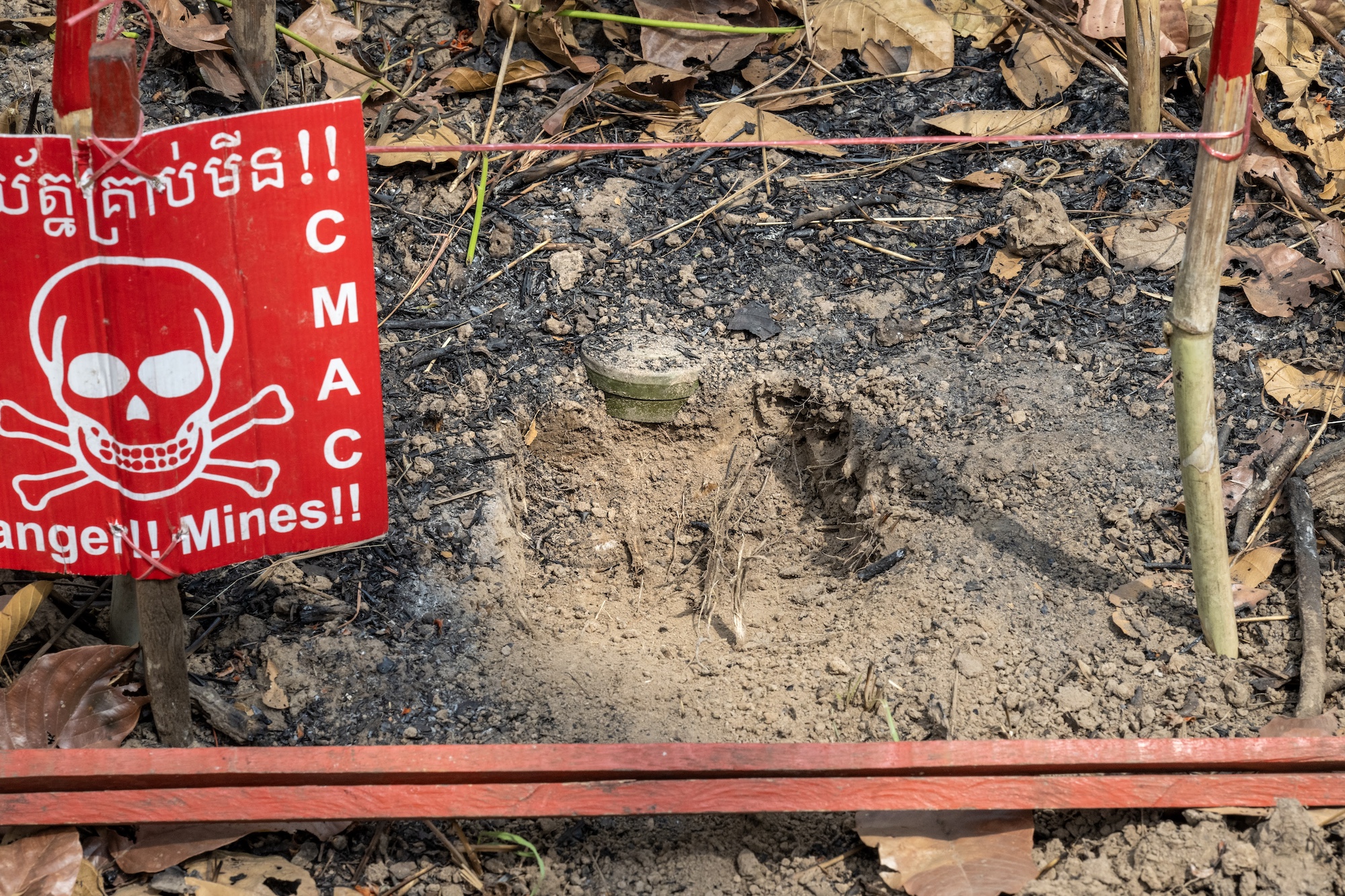
With respect to landmine detection, research in the Analytic Chemistry Laboratory is determining the environmental factors that affect the transport of explosive compounds through the soil/water and soil/air interfaces. Factors such as soil type, soil moisture content, soil temperature, duration and intensity of precipitation, vegetation, and type of mine all influence variables on the identity and quantity of explosive compounds in the physical sample and in the headspace is the main research focus.

For more than a decade, APOPO has trained rats to detect landmines by first teaching them to emit indication responses to training samples comprising soil spiked with small quantities of military-grade TNT dissolved in water. This procedure is clearly effective, as evidenced by the excellent performance of APOPO's mine-detection rats in Mozambique. Research from the analytical chemistry lab suggests, however, that such training samples produce relative low levels of TNT in the headspace. Therefore, other methods of producing training samples are being investigated, including using soil spiked with water in which a landmine has been soaked. Such water contains a "bouquet" of odors characteristics of the landmine that the rats potentially could identify and might prove especially effective in producing training samples that facilitate rapid training and ready identification of operational samples with very low levels of TNT and associated compounds. Such samples are likely to be likely to be obtained when the rats are used in Remote Explosives Scent Tracing applications, which APOPO has explored for several years.

Remote Explosives Scent Tracing is a special application of a broader concept, Remote Scent Tracing. In its generic form, Remote Scent Tracing involves collecting samples of air, dust, or soil from defined locations suspected of containing an item of interest, for example, landmines, illicit drugs, or contraband tobacco, and presenting those samples to either mechanical or animate detectors in another (i.e., remote) location. The areas corresponding to those samples that are judged to be positive by the detectors are then searched more thoroughly by other detection methods. For example, to determine whether contraband tobacco was present in shipping containers moving through a particular port, air from within those containers could be drawn through filters that are subsequently presented to rats trained to emit indicator responses when they smell tobacco. If the rats emit the indicator to the filter from a container, it is suspected of containing tobacco and subsequently searched. Analytical chemistry provides a means of determining the actual chemicals that control indicator responses in rats trained to detect tobacco or other substances, as well as the lowest headspace levels of those chemicals that rats trained in a particular fashion can detect. This information can be used to determine whether particular sampling procedures allow for reliable detection. If, for instance, samples taken from containers known to contain tobacco contain too little of the chemical or chemicals that the rats detect, then the procedure used to collect those samples is untenable. Absent such an analysis, sampling procedures can be evaluated only by trial-and-error development and testing, which is slow, costly, and often ineffective.

An exciting application of APOPO's rats is in detecting human tuberculosis by sniffing sputum samples. The chemistry team has been investigating the volatile compounds in the sputum of patients who have tuberculosis that trigger indication responses in the rats. Findings will be of value in preparing and presenting training and operational sputum samples. Moreover, we currently are investigating whether other Mycobacterium share odor cues with M. tuberculosis, the organism that causes TB. Although not normally pathogenic in humans, these bacteria might produce opportunistic infections in people with HIV, hence compromised immunity.

Previous research indicates that M. tuberculosis, which is a major cause of death in people with HIV in the developing world, is especially difficult to detect in sputum smears provided by members of this population. Analytical chemistry will enable us to determine whether as we suspect levels of the compounds tested by our rats are especially low in HIV-positive patients. If so, behavioral training procedures that maximize sensitivity to low concentrations will have to be investigated. Finally, research is also being conducted to study the scientific, technical, and clinical feasibility of breath-sampling for mass TB screening. If breath samples contain detectable levels of TB-associated volatiles, which analytical chemistry can determine, then the method merits further investigation.

Lab Capacity
Our ion mobility spectrometer (Smiths Detection, IONSCAN 400 B) can be used to detect illicit drugs, explosives and unexploded ordnance. Samples can be collected by wiping swabs or by suction with the DC Remote Sampler onto porous filters mounted in cartridges.

We have a microwave labstation (Milestone, ETHOS 1, Pro-24) for digestion, drying and evaporation/concentration procedures. Although we mainly use it for leaching explosive compounds from soil matrix (Swedish Defense Research Agency, FOI method) the system can be used for extraction of organic pollutants (e.g., pesticides and herbicides) from environmental and biological samples, to digest environmental and biological samples for trace inorganic analysis, and microwave assisted synthesis.

The VacMaster Sample Processing Station is used to filter the leachates (extracts), to concentrate the analytes onto Solid Phase Extraction and elution for final analysis. Alternatively we have an off-line headspace sampling set up with Solid Phase Microextraction (SPME) for subsequent manual injection to the gas chromatograph.

Our gas chromatograph (Agilent 6890N) can be run with an element specific detector (Nitrogen Phosphorus Detector, DET 0438) or with a mass spectrometric detector (Agilent 5975C). The former is used to detect specific groups of compounds (nitrogen containing) and the latter is used to detect all sorts of compounds separated by the GC.

Liquid samples (or extracts) can be automatically injected by the Automatic Liquid Sampler (Agilent 7683B Series Injector) or the headspace sampler can take the vapor in the headspace and automatically transfer it to the GC injection port. The latter avoids extraction procedures that are usually optimized to be specific for a certain group of compounds, lengthy, labor intensive and sometimes involves dangerous solvents. The headspace sampler however transfers everything in the headspace, can handle 70 samples and can be run unattended.

Our laboratory is open to collaborative or contract work with parties interested in having environmental samples analyzed for explosive compounds, narcotics, organic pollutants, or chemicals related to infectious diseases or in developing methods for detecting these substances.