- Which rat?
- Do rats smell better then dogs?
- Are rats likely to get killed in the detection process?
- How are rats being trained?
- How long can a rat work?
- Are they resistant to tropical diseases?
- What do rats eat?
- Do they need a lot of care and attention?
- Is there any cultural problem in handling rats?
- Can different people handle one rat?
- What does a trained rat cost?
- Will rats outrange dogs as mine detection animals?
Which rat?
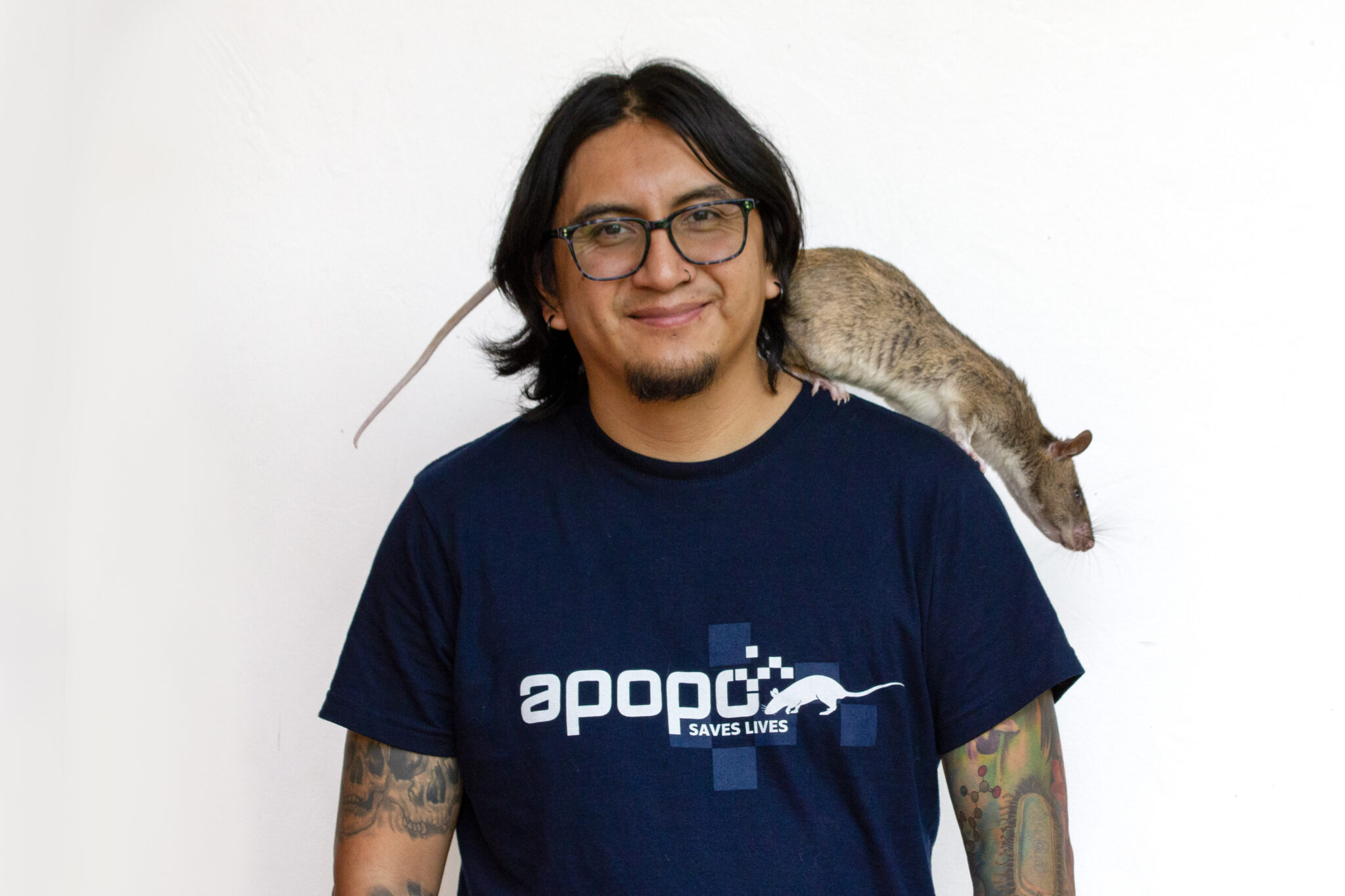
Rodents are the biggest order of mammals, including almost 2000 species. Among these, APOPO selected the African Giant Pouched rat or 'Cricetomys gambianus' for the mine detection task.
Though most rats would basically qualify in terms of sensitivity and intelligence, the 'Cricetomys' is showing some specific advantages for the mine detection task:
- With a focus on the African continent, the 'Cricetomys' is a widespread indigenous species, adapted to the local environment.
- The Giant Pouched Rat can reach a lifespan of up to eight years, optimising the return on training investment.
- The 'Cricetomys' relatively big size for a rodent, makes it better fit to work in the field and be observed.
- Being already introduced as a house pet, the 'Cricetomys' is calm, docile and easy to be tamed.
- Being a wild species, it was argued that their olfactory capacity would be at peak performance.
African Giant Pouched rats weigh between 0,7 and 1,5 kg, their average body length is 30-40 cm, excluding the tail of 40 cm.
They live in burrows underground, where they usually have different chambers.
They collect food and other kinds of items in their pouches, store it underground, and always trace their way back by sense of smell behaviour similar to the de-mining task.
Being night animals they are relatively calm and manageable during daytime, though prone to heat strokes if exposed to excessive sunlight.
Do rats smell better then dogs?
Dogs are traditionally renowned for their tracking and sniffing capacities.
Can rats match their performance? In the wild, rats can communicate over large distances using olfactory cues.
Observing the animal, one can notice its nose being constantly very active and moving.
Having poor vision, the 'Cricetomys' depends largely on its sense of smell.
To our knowledge, nobody so far has been able to quantify exactly the smelling capacities of rats or dogs for explosive targets.
From experience however, it is clear that the sensitivity of both animals is sufficient to detect the vapour signature from buried landmines, and even to evaluate vapour filters from suspected minefields.
One clear advantage of their small size compared to dogs, is that the rats' nose is always close to the ground, even if the head is raised.
The highest vapour concentration and the lowest wind speed are found close to the ground.
Though being trained on TNT, it is not clear which single component or combination of substances (bouquet) in the explosive compounds, is detected by the animals.
APOPO is currently carrying out a study to determine the detection threshold for the pure TNT vapours.
Are rats likely to get killed in the detection process?
The rats are trained to detect and pinpoint the location of the landmine.
Their lightweight makes it highly unlikely they would set of a mine by scratching or pointing.
It is a misunderstanding that the rats are trained as Kamikaze to destroy the mines in the field.
Trained animals are far too precious to be lost by setting of landmines.
On the contrary, the rats used by APOPO are treated with great care and attention, in order to optimise their physical and mental condition.
How are rats being trained?
APOPO principally uses a combination of click training and food rewarding.
As such, the rats work for food, and their performance is being positively rewarded.
Probably the main difference with most dog training is that the rats are not taught obedience.
As such, the total training period can be relatively short.
In APOPO's experience so far the field rats can be trained between 6 to 10 months, and REST rats between 4 to 6 months.
Training starts at the age of 5 weeks when juveniles are weaned from the mother.
At first, the animals are taught to associate the click sound with a food reward.
Then they have to perform certain tasks to get this food reward.
After odour imprint, the complexity of their tasks to be performed is gradually increased.
Intellectually, the rats are 'smart' enough to learn the desired tasks relatively quickly, while being 'uncomplicated' enough for learning to be standardised.
Food provides a strong and controllable source of motivation and an effective drive for performance.
How long can a rat work?
Normally, the rats are trained about half an hour per day, five days per week.
During this period, they are on a food-for-work diet; while during the weekend they feast on an extensive varied meal.
For their REST task, evaluating filters they can evaluate between 100 and 150 filters in about 15 minutes.
Recent experiments are suggesting that rats could work for such a period twice a day.
On the field, the free running rats scan a 100m2 box in averagely 28 minutes.
Are they resistant to tropical diseases?
Veterinary care requirements are relatively small for African giant pouched rats.
Since they are endemic to sub Saharan Africa, they are less vulnerable to local diseases compared to imported animals.
Routine care includes daily observations of all individuals, weekly health reports and prevention of endo- and ectoparasites.
What do rats eat?
The trained rats are living on their reward diet during working days, consisting mainly of banana and peanuts.
During the weekend, they get a balanced diet of grains, maize, nuts, vegetables, fruits, fish and sometimes insects.
This is also the permanent diet for the breeding rats.
Rats generally eat a great variety of food, and food supply can rarely be a problem.
Do they need a lot of care and attention?
Rats are very social animals.
They like a lot to be petted.
They enjoy a daily walk, like dogs do.
APOPO provided a free open run where the rats can play or habituate to the outside environment.
Other rats walk around freely in the kennel during clean up of their cages, as they do not attempt to escape.
They like to wander around and explore new environments.
APOPO nurses the babies before initial training starts, in order to make them used to humans and their sounds and smells.
Is there any cultural problem in handling rats?
In APOPO's experience, all trainers who have been employed to train the animals (mostly Tanzanians) have picked up the training job quickly.
There have been no cases of fear among the trainers, nor cases of mistreating or rough handling of the rats, which could initiate fear in them.
In general we observe quite gentle handling and respectful interaction with the animals.
Based on this positive experience, APOPO expects that users in the de-mining community will quickly get accustomed to this new intruder.
Future experience at different locations could reveal cultural differences related to the acceptance of the de-mining rat.
There have been some areas as well were de-mining dogs were not appreciated on religious grounds.
Can different people handle one rat?
An important advantage of the rats is their relative independence from a personal handler.
Generally, most rats remain with the same trainer, but show no significant difference in performance when taken over by somebody else in the absence of the trainer.
Preferably, the new handler should be briefed before on the behaviour of the specific rat.
A rat could thus be trained by several people, or more importantly, be trained by one person and be tested or handled on the field by another.
This has the logistic advantage that a handler does not necessarily have to follow his own animals to the de-mining operations.
What does a trained rat cost?
Rats have a potential cost advantage in terms of a shorter training period, easier transport and fewer maintenance requirements, lesser health care, bigger number of rats daily trained by one person and lower initial purchasing price.
An exact cost calculation of the rodent mine detection technology will only be possible after relevant operational field experience over a period of time.
A direct comparison with dogs could be made if a detailed cost analysis of mine dog detection is available.
Will rats outrange dogs as mine detection animals?
In fact, MD rats and MD dogs might very well be complementary tools within the mine action technology toolbox.
For the use of rats in the open field, we noticed that rats are good in scanning dense minefields, while the use of MD dogs will be avoided in that case.
In the contrary, dogs can cover bigger distances, and are better in a fast survey, e.g. in case of quality control.
For the use of rats in the REST system specific advantages are obvious.
Their small size allows a REST set-up to be small and easily managed.
This reflects in working speed by faster changing of samples.
Rats tend to work in a more 'mechanical' way compared to dogs.
Dogs have the clear advantage of being used by humankind for mine detection since decades.
Hence there are a lot of training companies and many experienced dog trainers.
If the same perspective applies to rats - for sure it will need considerable time and efforts.